Last year (02025), March 5th, we participated in a big international architecture competition in Amsterdam. It was called : Shift.
The challenge sounded deceptively simple: Design a landmark so powerful that it would change the way people think.
A structure, monument, or building capable of shifting minds. A landmark so powerful that it would inspire people to change their behaviour towards our planet.
At first, I loved the idea. What architect wouldn’t? The opportunity to create something meaningful. Something transformative. Something that could genuinely make the world a better place.
But the longer we worked on it, the more impossible the challenge became. Eventually, I even started to resent it.
Because think about it : If the pyramids haven’t succeeded in permanently changing human behaviour…? If thousands of years of monuments, museums, churches, books and universities haven’t managed to stop wars, greed, corruption, loneliness, burnout and environmental destruction…?
Who was I to believe that some architecture office from a small town north of Antwerp was somehow going to pull this off? That we could influence how people live, connect, and respect the world around them?
For weeks, our entire team wrestled with the challenge. We explored monuments. Anti-monuments. Buildings. Non-buildings. Landscapes.
We even considered a giant excavation in the ground exposing Amsterdam’s geological layers and rising water levels.
But nothing felt right. Because every solution seemed to address the symptoms. Not the source.
The deadline was 23:00. It was already well past lunchtime, and we still didn’t have a design.
Weeks had gone by. Countless discussions. Sketches. Dead ends. And this was where we had arrived. YU can clearly see the struggle. Not just architecturally, but philosophically.
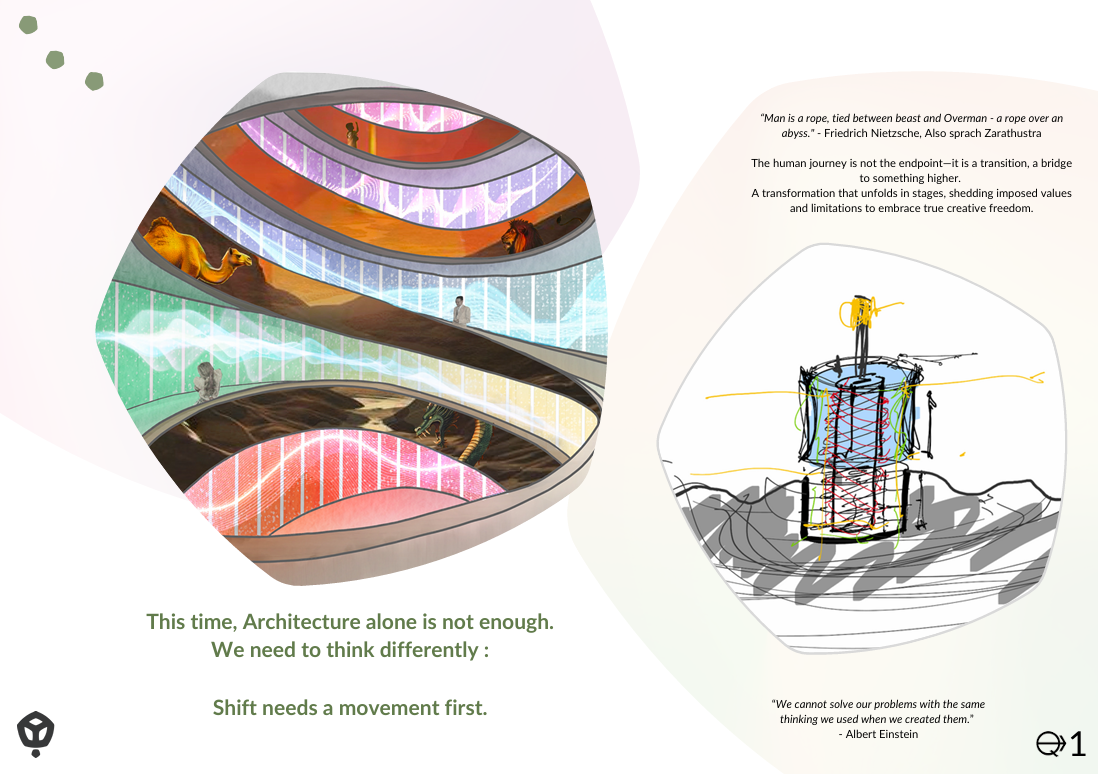
Somewhere along the way we had stopped designing a building and started questioning humanity itself. Even Nietzsche’s Also Sprach Zarathustra had found its way into the proposal. We were exploring transformation. Evolution. The journey from camel, to lion, to child.
The possibility that humanity itself might be the real landmark.
Interesting? Definitely. A competition-winning design? Not exactly.
At 15:55, we still didn’t have a final design. I know the exact time, because that moment the news came in. Something happened that changed the question forever.
We received news that someone we knew very well had taken his own life…
Suddenly, the competition wasn’t theoretical anymore. It became painfully personal.
Because he wasn’t someone who seemed likely to give up.
He had a loving wife. A beautiful little daughter. His own fitness coaching business.
He was passionate about health.
And he always wore orange. The colour of joy, of optimism. Of trust.
Which was why I trusted him.
Looking back, the signs were there.
The early morning phone calls at 6 AM. The moments when he needed someone to listen. The struggles hidden behind the smile. The endless healthy snacks he brought to the office. Far more than any of us could possibly eat. Almost as if he wanted to be noticed.
And yet, I never realised how close he was to the edge.
I saw the pain. But I also saw the orange. The laughter. The optimism. The part of him that seemed indestructible.
And I believed that part would win.
It didn’t.
My husband Koen crashed when he heard the news, he was devastated. So I sent him home.
The whole team looked at me, waiting for the next step.
I had no idea what that step was.
Because on that day (March 5th 02025) I stopped asking :
“How do we design a landmark that changes minds?”
instead the question became : “How could I have changed his?”
What on earth could an architect possibly design that would be powerful enough to change the mind of someone who had already lost hope??
How the hell could I have helped him see another possibility? Another day?
DAMN IT!
And if we couldn’t prevent someone like him from giving up… Then how are we going to help future generations?
Because let’s be honest. The next generation is not exactly inheriting an easier world.
This was a man who exercised every day. Who understood nutrition better than most people. Who had a loving family. And even he reached a point where life became too heavy.
So what about the children growing up today?
Children entering a world where housing becomes less affordable, resources become scarcer, climate change continues to accelerate, artificial intelligence is transforming entire industries, and where corruption still too often seems to outperform honesty and integrity.
How are they supposed to navigate all of that? How do we help them remain hopeful?
What do we need to design to help them find their purpose when life becomes difficult?
What do we need to create to prevent people from giving up the way he did?
That question never left me.
In fact, it has occupied my mind ever since.
We didn’t win the competition. We never submitted an actual building proposal either.
We submitted a vision. A vision that was already growing beyond architecture.
But even that vision was incomplete. I needed more time.
So the question stayed with me. For more than a year, I followed it down the rabbit hole.
Not because I wanted to. Because I had to.
Because once someone YU care about gives up on life, the question never really leaves YU.
It follows YU home. It sits beside YU at dinner. It wakes YU up at night.
And sooner or later, YU have only two choices:
Ignore the question.
Or turn the question into a quest.
That’s what I did.
I followed it.
All the way down the rabbit hole…
****
Hi dear reader,
My name is Nikki. I’m so happy YU are here.
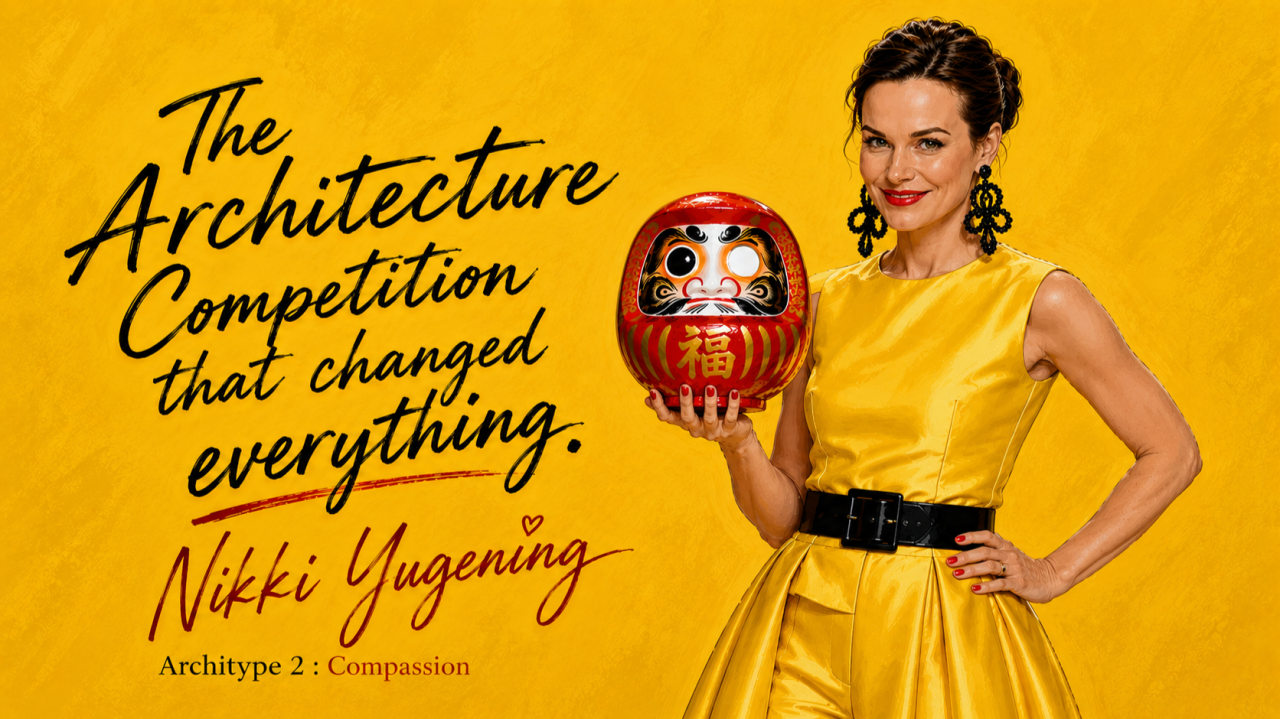
Perhaps YU have heard about me already. They call me Architype 2: Compassion. Some people say Kindness would have been a better name, but it doesn’t start with a C, and Véronique was determined to collect 9 C’s. So Compassion it became.
I’m known for being a bit of a people pleaser. I trust people. I believe most humans are genuinely trying to do the right thing, even when they occasionally make mistakes, or forget who they are.
I feel everything.
I cry at airport reunions. When people fall into each other’s arms after months apart.
I cry when I see love. Real love. A parent holding a child. A friend showing up when life gets difficult. The quiet moments that remind us we’re not alone.
I talk to everything with four legs and a tail, as if they understand me. (they do!) Three-legged animals too, because they deserve a little extra love.
Our house is filled with Daruma dolls. One eye coloured in. Always hoping. Always believing. Always waiting for another dream to come true.
People call me naïve. But I’m not naïve. I’m deliberately hopeful. There is a difference.
I choose hope. Every single day. Even when life gives me reasons not to. Especially then. Because hope is not blindness. It is Courage wearing a softer face.
That’s why my twin sister exists. Nikki ‘O. Architype 2*: Courage.
She was created because sometimes my empathy needs boundaries. I need someone to stand beside me and say: “Enough.”
And despite everything, I still believe people are good. I even feel for the villains in my story. Not because what they did was right. But because I can see beyond the behaviour. I see pain. Patterns. Brokenness.
And while Nikki ‘O guards the gate, I still wonder what happened to them before they became who they are.
My favourite song is Bright Eyes by Art Garfunkel. Maybe because it reminds me that vulnerability isn’t something to hide. It’s something to honour.
I will always believe in people.
And I will keep colouring Daruma eyes until the dreams come true. Because someone has to keep hope alive.
Lots of Love,
Nikki
Architype 2: Compassion
The Keeper of Hope in The Story of YU.