Yes! Finally I get to answer this question.
And believe me, I’ve been waiting a long time for it.
Because biophilic design is one of the cornerstones of YUGENING Architecture.
Today everyone seems to know the term. But when I started talking about it 26 years ago, that wasn’t exactly the case.
Back then, when I explained the word biophilia to certain audiences, the reactions were sometimes…
“Oh, that sounds like pedophilia”.

Yes. That actually happened. More than once.
I kid YU not.
Maybe my audience wasn’t always very sophisticated.
Anyway.
Biophilia simply means love of life and love of nature.
The term was popularized by biologist Edward O. Wilson, who proposed that humans have an innate connection with the natural world.
Which makes perfect sense. For more than 99% of human history, we lived in nature.
Nature wasn’t something we visited on weekends. It was our home.
Only recently have we locked ourselves inside concrete boxes, under fluorescent lights, breathing recycled air and staring at screens all day.
And then we wonder why we’re stressed, exhausted and disconnected.
Biophilic Design is the practice of bringing the beneficial qualities of nature back into the spaces where we live, work, learn and heal.
And no, it is not just about putting a sad plant in the corner of the room. It’s much broader than that :
Natural daylight. Fresh air. Views towards nature. Natural materials such as wood and stone.
Organic shapes and patterns. Water features. Variations in light, temperature and airflow.
A sense of refuge. A sense of belonging. A feeling of comfort and familiarity.
The ways to bring nature back into our built environment are almost limitless.
Even just images of nature instead of real plants can have measurable effects on the human brain.
Studies show that biophilic environments can:
- Reduce stress, burnout and anxiety
- Lower blood pressure
- Improve concentration
- Accelerate healing
- Reduce pain perception
- Improve mood
In healthcare environments, the effects can be particularly remarkable.
In fact, a few relatively small changes can completely transform how a space is experienced.
Let me give you an example.
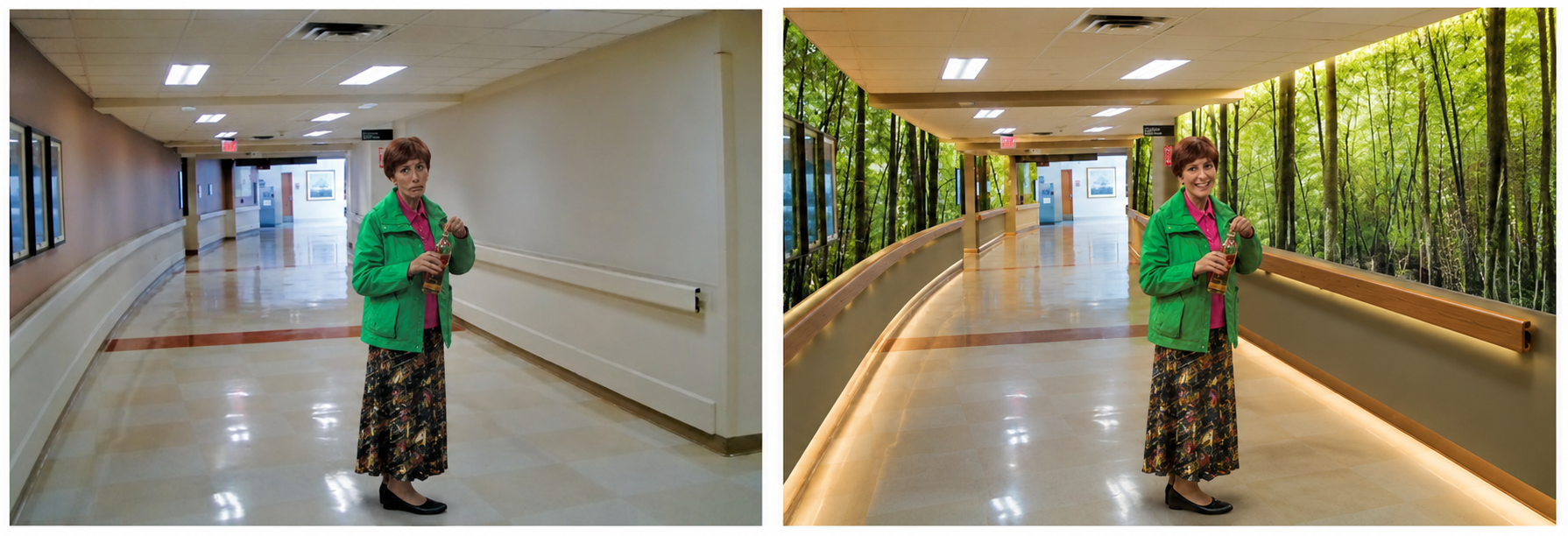
Meet ‘Zatte Rita’.
Rita just had a hip replacement. The doctor wants her walking as soon as possible because movement accelerates recovery.
On the left, Rita looks down the corridor and thinks: “Nope.” The corridor feels cold, clinical and depressing. Walking there feels like punishment. She turns around and goes back to bed. She now needs a drink to recover from this experience.
On the right, Rita sees something completely different. Timber handrails. Soft indirect lighting. Forest imagery. Maybe walking isn’t such a terrible idea after all! She’s doing more steps than the doctor recommended! Yuhuuuu! Let’s celebrate with a drink!
Suddenly, the corridor becomes part of the therapy. Not decoration, therapy.
Now, of course, this is just an example. In real life Rita doesn’t drink whisky. She drinks ‘champetterkes’, which means champagne in Antwerp dialect.
But you get the point.
What’s interesting is this :
This isn’t just a silly story. Studies have shown that exposure to nature and biophilic environments can significantly improve recovery outcomes, reduce stress and even shorten rehabilitation periods by up to 15%!
So if the evidence is this clear, the following questions should pop up :
If we know these environments are healthier, that they help people heal and improve wellbeing…
…then why are so many buildings still designed as if humans were machines?
Architecture should do more than protect us from the rain. It should help us flourish. Thrive. Support.
Because the spaces around us shape how we feel, how we think, how we heal and how we connect.
We spend roughly 90% of our lives indoors. Let that sink in. Ninety percent.
If food affects our health…
And water affects our health…
Why would the spaces surrounding us be any different?
Our surroundings may be influencing us far more than we think.
Rita thought she was making a rational decision. Her brain had already made up its mind.
Because our bodies are constantly responding to the spaces around us, whether we realize it or not.
The only question is:
Are those spaces helping us…
Or making us reach for a drink?
Rita deserves Biophilic Design.
And so do YU.
That’s YUGENING.
*****
My name is Veronica.
I am one of Véronique Orens’ alter egos. Or as she prefers to call them: Architypes. These Architypes (with an “i”, because the ArchEtypes already belong to Carl Jung. But don’t ask me how the pronunciation is any different), were created from Architecture. Hence the ‘i’ in Architype.
There are 9 Architypes in total. YU will get to know them one by one. And yes, we know. It’s a lot to take in. An architect with 26 years of experience, once considered a highly respected professional, suddenly showing up with 9 alter egos after two years of isolation…
It does sound slightly insane.
That’s why we call it ; The Crazy Circus. Yes, we have gone bonkers and we love it. Maybe the world could use a little more beautiful madness right now.
I myself represent the Architype of Curiosity. I have always loved curious people. The nerds. The passionate misfits. Hence the red dress and the ‘sexy’ name ‘Veronica’, referring to Veronica Lake. Because she had a high IQ but didn’t look like the stereotypical “nerd.” And that’s exactly the point. There are countless brilliant women out there constantly being underestimated because of the way they look. Too beautiful to possibly be intelligent.
But the same thing happens to men who managed to keep a soft heart in a world that often rewards emotional distance. Somewhere along the way, vulnerability and empathy became mistaken for weakness. And seriousness for intelligence.
That story is getting old. It’s time for a new story.

Dear Steve,
This one is for YU :
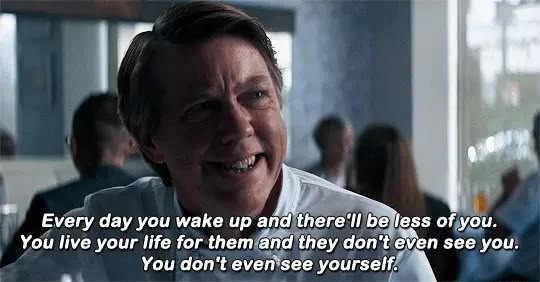
Yesterday, YU mentioned this scene from Pig.
And it made me realize something.
For years, I mostly showed my work, the buildings, the projects in the most polished way.
But rarely my true self.
That is exactly what I’m trying to change right now. And yes, sometimes I still wonder if it’s the right thing to do.
But if people don’t get to see who YU really are, why would they care?
Perhaps that’s also why some buildings leave us completely indifferent.
They function. They perform. Efficient. They look ‘ok’. But they never reveal a soul.
And if a building doesn’t reveal anything about itself…
Why would anyone care?
Thank YU for caring.
Véronique









Thank YU for caring.
Véronique