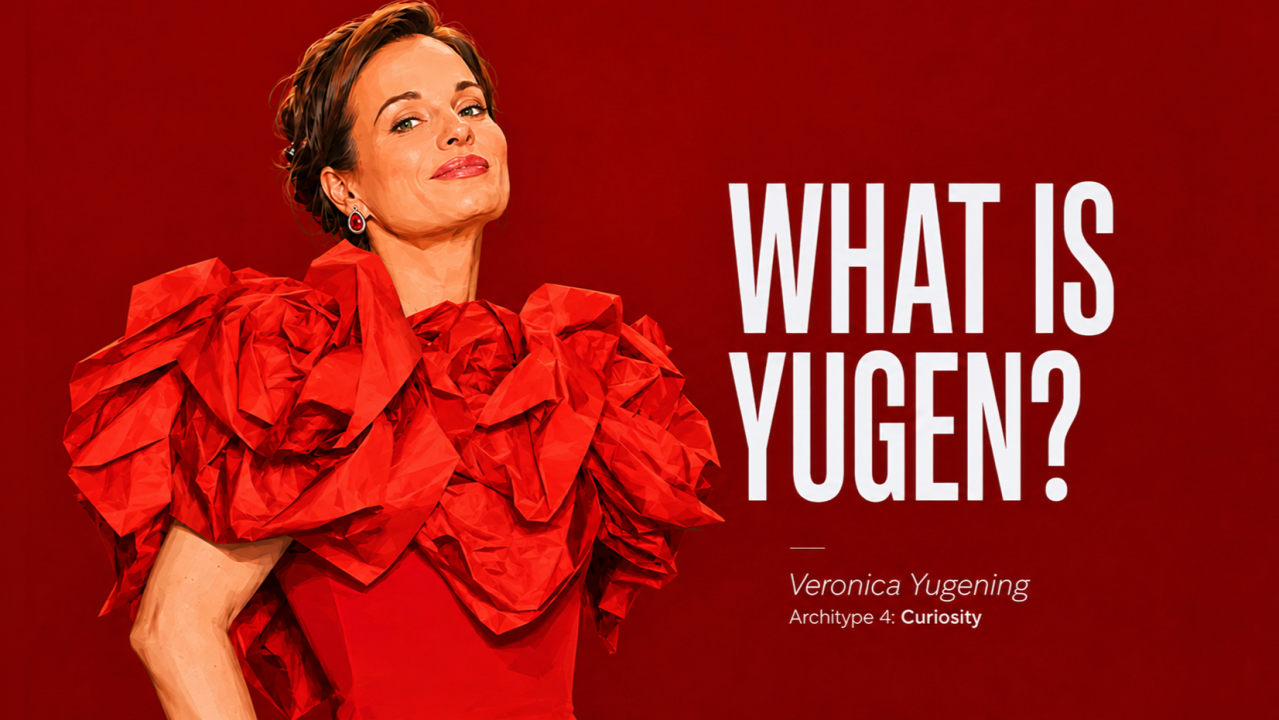
Aaaah… now this is where it gets beautiful.
“A thing of beauty is a joy forever.” – John Keats
Koen Van Grimbergen (love of my life and architect) quotes this very often. He once discovered this quote on the back of a file from his mathematics teacher, and it became one of the foundations of our lives.
I guess I learned more about beauty from Koen than I ever learned at architecture school. For Koen beauty is not just decoration, but something deeper. Something almost impossible to explain.
The Japanese have a word for it:
YÜGEN.
An aesthetic philosophy describing a profound, mysterious beauty that can never be fully expressed in words.
And here’s the beautiful part: YÜGEN actually has two meanings. (Pay attention, YU are about to learn something today. My dad used to say: “YU learned something today, so today was a good day.”)
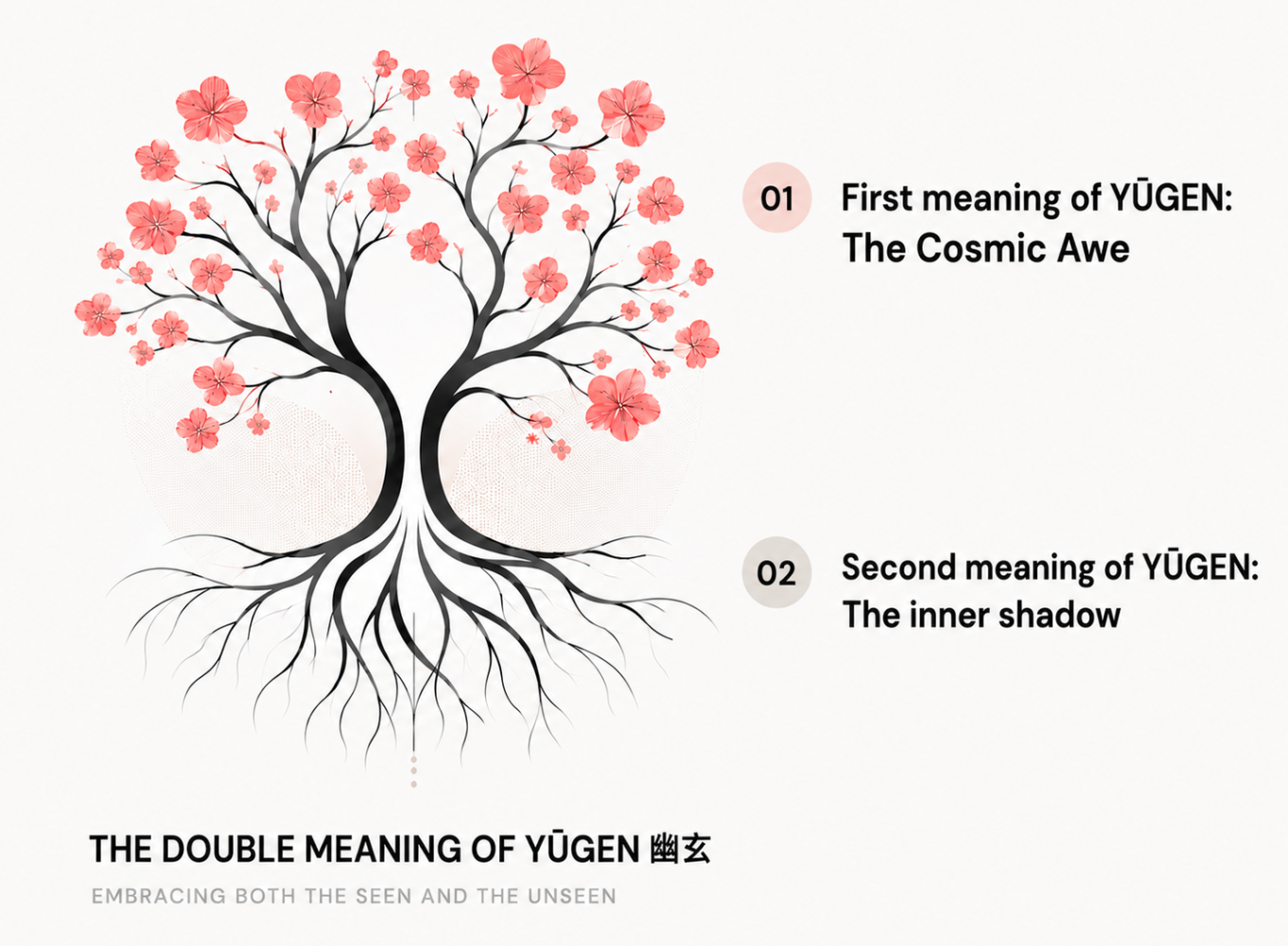
First Meaning of YÜGEN: The Cosmic Awe
A Japanese concept describing the profound, mysterious beauty that words cannot capture.
It is not the beauty of the obvious, but of unseen, the subtle depth of existence that can only be felt, never fully explained. It is the overwhelming feeling of awe when gazing at a galaxy of stars, standing before an ancient tree, or noticing strange shadows appear during a solar eclipse. It reminds us of our own smallness within an infinite universe.
Second Meaning of YÜGEN: The Inner Shadow
The shadow within us all. The dark side we hide, fear, or deny.
It represents the hidden parts of our psyche: the thoughts, fears, desires, grief, and vulnerabilities we conceal from the world. Yet, just like the shadows in a Japanese garden that give depth to the light, this darkness is not inherently evil.
YÜGEN reminds us that what is hidden often supports what is visible and admired. True beauty exists in the tension between both.
Just like a tree with a magnificent crown: without deep roots, there can be no flourishing canopy.
Some examples of YÜGEN :
- The silence after a powerful piece of Max Richter music.
- When YU look at the stars and suddenly feel both tiny and deeply connected to the universe.
- The beauty of the little footstep of your children in the sand that immediately gets washed away and the realization that such a moment can never truly be held onto.
And what does this have to do with architecture, YU ask?
Everything! I truly hope YU will recognize the feeling in some of these examples, because it would mean YU have paying attention to this precious life:
- When YU enter a forgotten ruin where nature and time have merged together.
- When YU walk into a sacred space and immediately feel the silent energy.
- When YU discover a hidden courtyard in a dense city and suddenly experiencing silence and peace. Antwerp is filled with places like this.
- When YU touch an ancient stone staircase, curved thousands of unknown lives before yours.
- When YU walk through a narrow compressed hallway that suddenly opens into a vast luminous room.
YÜGEN is the awareness that there is always something more beneath the surface. Something present, but almost unnoticed by people trapped in the endless rat race of modern life.
And guess what? We don’t even have a proper word for it in the West. Can YU imagine? For something so beautiful, we don’t have a word. Unbelievable.
Maybe Japanese culture remained more connected to subtlety and the invisible layers of existence. Or maybe their senses stayed more open to the vastness of the universe
Or maybe we in the West became so distracted by speed, productivity, and noise that these subtle YÜGEN moments simply pass us by.
Or worse: maybe we do feel them… but without a word for them, we fail to recognize them.
Well…
Now YU do.
And YU know what’s truly beautiful about YÜGEN?
It starts with YU.
*****
My name is Veronica.
I am one of Véronique Orens’ alter egos. Or as she prefers to call them: Architypes. These Architypes (with an “i”, because the ArchEtypes already belong to Carl Jung. But don’t ask me how the pronounciation is any different), were created from Architecture. Hence the ‘i’ in Architype.
There are 9 Architypes in total. YU will get to know them one by one. And yes, we know. It’s a lot to take in. An architect with 26 years of experience, once considered a highly respected professional (or so I heard), suddenly showing up with 9 alter egos after two years of isolation…
It does sound slightly insane.
That’s why we call it ; The Crazy Circus. Yes, we have gone bonkers and we love it. Maybe the world could use a little more beautiful madness right now.
I myself represent the Architype of Curiosity. I have always loved curious people. The nerds. The passionate misfits. Hence the red dress and the ‘sexy’ name ‘Veronica’, referring to Veronica Lake. Because she had a high IQ but didn’t look like the stereotypical “nerd.” And that’s exactly the point. There are countless brilliant women out there constantly being underestimated because of the way they look. Too beautiful to possibly be intelligent.
But the same thing happens to men who managed to keep a soft heart in a world that often rewards emotional distance. Somewhere along the way, vulnerability and empathy became mistaken for weakness. And seriousness for intelligence.
That story is getting old. It’s time for a new story.